Prompt used
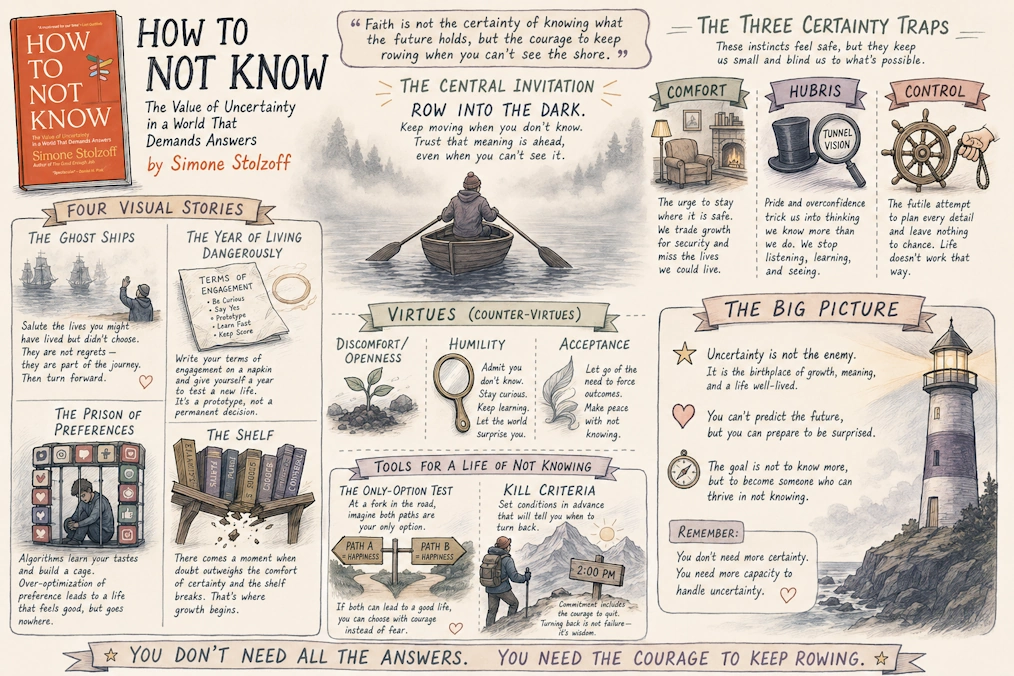
Create a sketchnote summarizing How to Not Know by Simone Stolzoff.
Central Image: A rowboat in a heavy fog with a figure ‘rowing into the dark,’ representing the idea of maintaining faith by continuing to move forward even when the destination is hidden.
The Three Certainty Traps: Create three distinct branches for the ‘Certainty Traps’:
- Comfort: Icon of a warm, lit room or a safe, representing the urge to stay where it is safe and avoid the risk of new possibilities.
- Hubris: Icon of an expert’s hat or a magnifying glass with ‘tunnel vision,’ showing how pride and overconfidence blind us to what we don’t know.
- Control: Icon of a steering wheel or a hand gripping a leash tightly, representing the futile attempt to plan every detail and leave nothing to chance.
Key Visual Stories:
- The Ghost Ships: Illustrate ‘phantom ships’ sailing away in the distance to represent the lives we might have lived but didn’t choose, and the importance of saluting them as we move forward.
- The Year of Living Dangerously: A waxy napkin with ‘terms of engagement’ written on it, representing the experiment of prototyping a new identity or life.
- The Prison of Preferences: A jail cell made of smartphone apps or algorithmic symbols, symbolizing how over-optimization based on our own tastes can trap us.
- The Shelf: A wooden shelf breaking under the weight of heavy books, symbolizing the moment doubt finally outweighs the comfort of certainty.
Virtues and Tools: Highlight the ‘counter-virtues’ of Discomfort/Openness, Humility, and Acceptance. Include the ‘Only-Option Test’ (a fork in the road where both paths lead to happiness) and ‘Kill Criteria’ (a mountaineer turning back at 2 p.m.).
Generation notes
I asked to generate the sketchnote in 16:9 aspect ratio and also using the Rose Pine Dawn colour palette.
Key concepts visualized
- The Foggy Rowboat: This is a core metaphor for the “Art of Not Knowing.” Stolzoff explains that innovators are like those in a rowboat on a foggy lake; they cannot see the land, but they must maintain faith and keep rowing to eventually reach it.
- The Three Traps: The book is structured around these three obstacles—Comfort, Hubris, and Control—which distort our view of reality and keep us from growing. Providing icons for these helps visualize how certainty acts as a barrier.
- Ghost Ships: Drawing on the “Dear Sugar” column by Cheryl Strayed, the book concludes with this metaphor to explain how we must deal with the loss inherent in every choice. This provides an emotional anchor for the sketchnote.
- The Year of Living Dangerously: This is the narrative spine of the book (Connie and Andrew’s story), illustrating that uncertainty is not a problem to be solved but a reality to be lived through experiments.
- The Prison of Preferences: This concept highlights the “explore-exploit trade-off” and warns that a perfectly optimized life based on current preferences misses the serendipity that exists outside our comfort zones.
- The Shelf: This is a poignant metaphor for the gradual loss of faith or the breaking point of a belief system when doubts become too heavy to ignore.
- Decision Tools: Including the Only-Option Test and Kill Criteria provides the “how-to” aspect of the book, showing the reader practical heuristics for making decisions under pressure without needing absolute certainty.